

Last Update: 15 October 2025
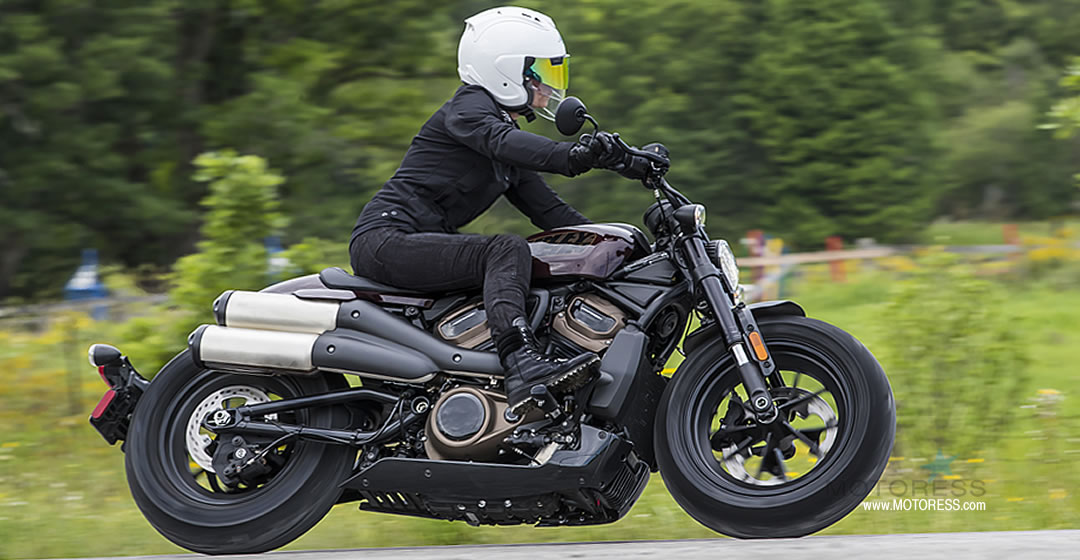
The new Harley-Davidson Sportster S packs a lot between its tires! It could be an attractive choice for Harley fanatics or cruiser fans seeking an upgrade in not only style and performance but technology. It’s wildly powerful and a decent all-round performer thanks to its spunky engine and techie features. Whether you see it or hear it before riding it, you know the Sportster S is different. And as I did during my ride review, when you get behind the handlebars, this Sportster’s primary purpose is obvious. It exists to give you a thrill.
On first impression, the differences are obvious by this Sportster restyled appearance. It’s a stunning rebirth of the historic Sportster model (since 1957) as a mid-engine cruiser with custom styling that instantly turns heads. The model brings two important links together: the enormous history of the Sportster model and the new, liquid-cooled 1250 cc engine that we know from the equally new Pan American adventure motorcycle launched earlier this year. Where the PanAm was a real game changer offering something for new buyers in a new segment (adventure riding) – for Harley. Now it’s a different story: suddenly the Revolution T powering is the basis for an icon of the classic American motorcycle brand, the first dramatically different Sportster in an eternity.
Sportster S Appearance
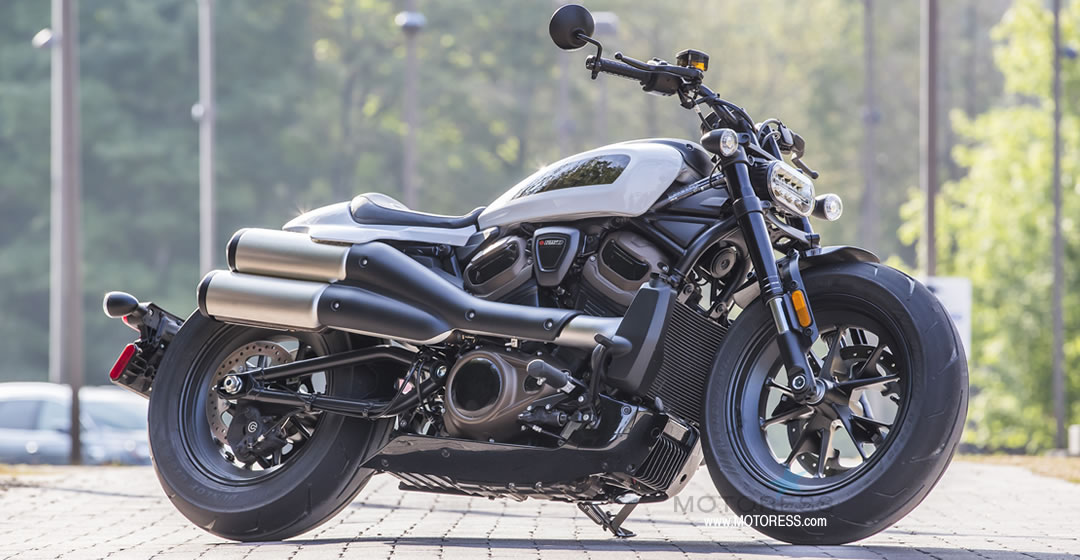
The Harley-Davidson Sportster S is one adept at rekindling and maybe redefining your cruiser spirit. Rewarding design dynamics are baked into every component, which wears a distinctive look that sets it further apart from its prior cruiser legacy.
Harley used “modular architecture” aiming at an uncluttered custom bike look. They used FEA (Finite Element Analysis) and advanced design optimisation technique in the engines design to minimised material mast in the cast and moulded components. This adds up to a thrilling power to weight ratio with a focus on – lightweight!
Harley is indeed making bigger steps where finishing is concerned. The Sportster S finishes, the LED light box on top of the thick front fork, the tiny front fender above that hugely thick front tire; all keep to that cool factor.

What I don’t understand however, is that the left side engine chassis is entirely different looking than that of the highly designed right. In fact, the left side of the bike is rather – unappealing. For the purists it will take some getting used to, but designers have still managed to turn it into a recognisable Sportster.
No Potatoes

We know the engine is from the Pan America but tuned differently with its 1250T engine giving off 121 HP and 125 Nm of power. That doesn’t change the fact that the Revolution Max 1250T powerplant will give a completely new experience for today’s Harley riders. The trade off means there’s no longer a classic “potato-potato-potato” sound. Gone is the lazy-like, heavily pounding chassis in the frame. This 1250T runs like a rocket, with the power high in the revs.
Not For Entry Level Riders
One thing is certain: this engine accelerates harder than any standard Harley cruiser model. From 3500 rpm onwards, it goes off extremely hard to extend to a maximum of 9500 rpm. At road speed of 100kmph I seldom got out of 5th gear. There are the necessary vibrations, but the grumbly usual ones are indeed gone. And in that exchange, you will get an enormous chunk of brutal speed and torque. I see this resulting in the Sportster losing its status as the “lightest” Harley for smaller motorcyclists and beginners. And with a starting price of $17,999 CAD / 14,999. USD it’s high price for an entry-level model.
Sportster S Gallery
Total Electronic Rider Assist Package
The electronics are impressively complete, with three preprogrammed ride modes: ROAD, SPORT and RAIN plus two additional custom riding modes which you create. that are easy to change and give the engine an easy switching change of character.
The built-in navigation (via the HD app) is also a great idea and there are also a lot of values to be extracted from the system. There is also traction control, anti-wheelie (!) and cornering ABS. Everything can be easily operated via the buttons on the handlebar, the company neatly mentions that all things like calling, radio and navigation are not on the engine itself but in the app on your phone.
Rider Safety Enhancements
The “cornering rider safety enhancements” on the Sportster S combine a collection of technologies. A matching of performance to available traction when you’re accelerating, decelerating, and braking. How it does this is through its equipped six-axis inertial measurement unit (IMU). This gauges and reports the lean angle while navigating a turn all the while managing available grip. The system intervenes accordingly when the motorcycle is leaned compared to when upright. This is a huge confidence builder during unpredictable situations or adverse road conditions.
Instrument Cluster-[ed]
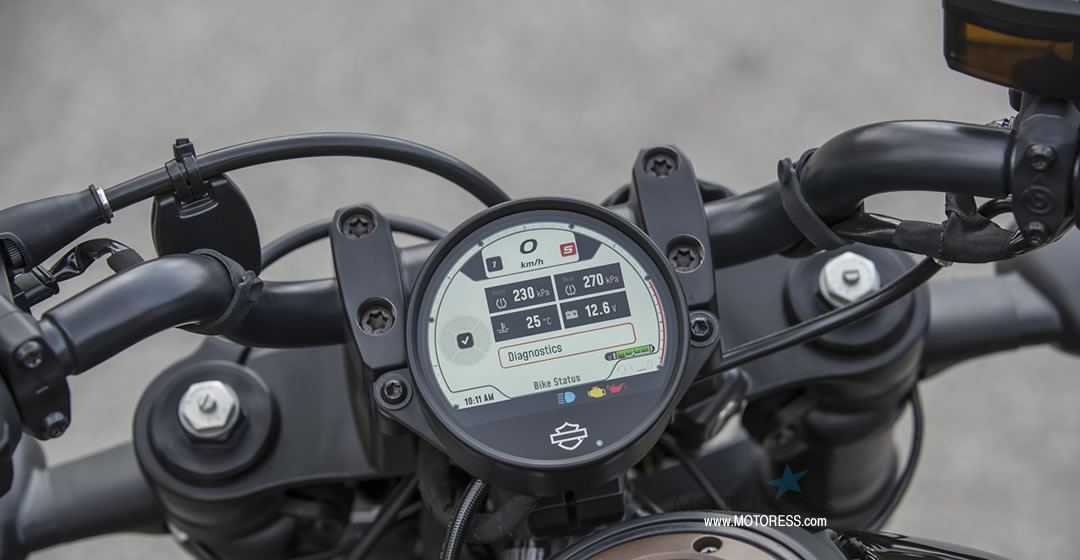
The Harley-Davidson Sportster S instrument cluster is stunningly bright, compact, but vast in operational options. Through this hub you can pair your phone for calls, sync music, and by way of the Harley app, obtain navigation. There is no GPS system, it all relies on Bluetooth connection. The problem I found though, is it not easily read. To adjust and implement while riding is like diving into the Matrix. This I see poses huge safety issues as you’ll need to take your eyes from the road to focus on the cluster.
Still A Hard Ride

The sitting position is as it should be on a cruiser. For taller riders, the standard forwards – forward foot controls at first seem like a stretch for shifting but would be optimal for longer legged riders. For the shorter to average height riders, the optional “mid controls / middles” would be better. I do wish they had a test bike set up with the middle pegs, but they did not. The fit was okay for me on a short distance ride. However, the middle peg setup would be perfect. I prefer the added performance feel I get from weighting pegs and a sit position with middle pegs.
The saddle offers a good secure sit. The rear suspension is undersized and intensely hard. So hard that you think it’s too soft (or: not present), as every bump, every asphalt hole and every stripe is felt through the rear. That also means that you must control the engine considerably, because the suspension can’t quite keep up if you go on the gas on bad asphalt.
Apex Slayer?

Cornering is of course a bit more work on the Sportster S due to its wide 160/70 front tire (my Triumph Speed Twin Roadster is 120/70). Generally motorcycles have a narrow front tire to aid in ease of turning. It will turn with some precision and most riders will find this sufficient. For my needs, it falls short of the accuracy I’d had hoped for.
In terms of slow speed balance, the Sportster S has again its challenges which I add up to simple ergonomics. And to be honest, my slow speed skills are honed. And even with that fat front tire and slightly too forward pegs, slow speeds and U-turns were no issue.
When in bumper-to-bumper traffic there is an uncomfortable issue that I can’t quite source. An air box or breather component from the engine blasted hot air to the inside ankle of my left (shifter lever) foot. The blast was so hot, I needed to keep my foot to the far left of the peg and during many moments, remove it form the peg and the heat source. Never have I ever experienced this. Plus, I wear motorcycle boots and riding pants which insulate heat from open concept motorcycles. Perhaps a small detail, however, it was unpleasant, and worth mention.
Harley-Davidson Sportster S Wrap Up

Overall, I like how the Sportster S brings Harley’s cruiser ethos to a class of “revolutionary”. The engine, being the core performance “feel” does it all for me. And since I’m not a Harley traditionalist, the Sportster S leaps forward in terms of taking a classic cruiser model to a new sportier demeanour. But it also has some usability issues that might give you pause.
The Sportster S offers a mind-bending package of quickness, handling and depending on your build, comfort on the road. The riding pleasure is certainly there!
Pros:
✔ Impressive list of advanced rider aids
✔Lightweight
✔ Stunning style and design
✔ Optional mid controls
✔ Excellent headlamp LED lighting
✔ Cruise control
✔ Passenger backrest kit; tail bag
Cons:
✘Confusing button layout; complex instrument panel
✘Poor rear suspension over bumps and potholes
✘Mid Controls should be a no-cost option
✘1-gallon tank is small for quality long-distance touring
| 2021 Harley-Davidson Sportster S Specifications | |
|---|---|
| Engine | Revolution Max 1250T |
| Valves | Chain-driven, DOHC, hydraulic self-adjusting lifters, intake & exhaust VVT; four valves per cylinder |
| Bore | 4.13 in. (105 mm) |
| Stroke | 2.85 in. (72.3 mm) |
| Displacement | 76.4 cu in (1,252 cc) |
| Compression Ratio | 12.0:1 |
| Horsepower | 121 hp at 7500 rpm (claimed) |
| Torque | 94 lb-ft. at 6000 rpm (claimed) |
| Fuel System | Electronic Sequential Port Fuel Injection (ESPFI) |
| Air Cleaner | Downdraft intake, tuned velocity stacks, washable filter media |
| Exhaust | 2-into-1-into-2; catalyst in muffler |
| Lubrication System | Semi-Dry Sump |
| Primary Drive | Gear, 49/89 ratio |
| Final Drive | Belt, 80/34 ratio |
| Clutch | Mechanical, 8 plate wet, assist & slip, 1090N |
| Transmission | 6-speed |
| Frame | Stressed-member, high strength low alloy steel trellis frame; stamped, cast, and forged junctions; MIG welded; aluminium forged mid-structure |
| Swingarm | High strength low alloy steel, tubular sections, stamped x-member, forged axle junctions; MIG welded |
| Front Fork | 43 mm inverted fork with compression, rebound and spring preload adjustability. Aluminium fork triple clamps. 3.6 inches of travel. |
| Rear Shocks | Linkage-mounted, piggyback monoshock with compression, rebound and hydraulic spring preload adjustability. 2.0 inches of travel. |
| Wheels, Front Type | Aluminium cast, satin black |
| Wheels, Front Width | 4.5 in. (114 mm) |
| Wheels, Front Height | 17 in. (432 mm) |
| Wheels, Rear Type | Aluminium cast, satin black |
| Wheels, Rear Width | 5 in. (127 mm) |
| Wheels, Rear Height | 16 in. (406 mm) |
| Front Brake | Radially mounted, monoblock, 4-piston caliper, 320 mm disc. |
| Rear Brake | Floating, single piston caliper, 260 mm disc |
| Brakes, Anti-Lock Braking System (ABS) | Standard |
| Lean Angle | 34° left and right |
| Fuel Economy | 49 mpg (4.8 l/100 km) (claimed) |
| Lights (as per country regulation), Headlamp | All LED headlamp, low and high beam with signature position lighting |
| Lights (as per country regulation), Tail/Stop | All LED Tail/Stop lamp with signature tail lighting |
| Lights (as per country regulation), Front Signal Lights | LED Bullet Turn Signals |
| Lights, Rear Turn Signals | LED Bullet Turn Signals |
| Gauges | 4 inch viewable area TFT display with speedometer, gear, odometer, fuel level, clock, trip, ambient temp, low temp alert, side stand down alert, TIP over alert, cruise, range and tachometer indication BT capable – phone pairing to access phone calls, music, navigation (H-D App ONLY) |
| Electric Power Outlet | USB C-Type , Output 5V at 2.4 Amp |
| Length | 89.2 in. (2,265 mm) |
| Overall Width | 33.2 in. (843 mm) |
| Overall Height | 42.9 in. (1,089 mm) |
| Seat Height, Laden | 28.9 in. (734 mm) |
| Seat Height, Unladen | 29.6 in. (753 mm) |
| Static Ground Clearance | 3.66 in. (93 mm) |
| Rake (steering head) (deg) | 30° |
| Fork Angle (deg) | 28° |
| Trail | 5.8 in. (148 mm) |
| Wheelbase | 59.8 in. (1,518 mm) |
| Front Tire | Harley-Davidson Series, radial Dunlop GT503 160/70TR17 73V |
| Rear Tire | Harley-Davidson Series, radial Dunlop GT503 180/70R16 77V |
| Fuel Capacity | 3.1 gal. (11.8 l) |
| Reserve Fuel Capacity, Fuel Injection (warning light) | 0.8 gal. (3 l) |
| Oil Capacity (w/filter) | 4.75 qt. (4.5 l) |
| Weight, In Running Order | 502 lb. (228 kg) (claimed) |
| Warranty | 24 months (unlimited mileage) |
| Service Interval | First 1,000 miles (1,600 km), every 5,000 miles (8,000 km) thereafter |