
Last Update: 16 February 2022

Carbon fibre (Carbon Fiber) for motorcycles is not only a fantastic looking accent but it’s truly a great tough material. Also commonly called graphite, it has special properties making it ideal for applications ranging from aerospace, to automobiles, to sporting goods. When combined with resin to form a composite, it produces parts that are extremely light and rigid which makes carbon fibre for motorcycles ideal. Its main attributes are strength and the fact that it’s light weight remains a bonus for motorcycles and very useful in high performance environments. Other than that there’s no other reason carbon fibre should be fitted to your motorcycle.
How Does Carbon Fibre Work?
In the past if you wanted to make something stiffer and stronger you needed to increase its physical mass (and therefore weight). Carbon fibre consists of strands of nylon fibre that have been carbonized with extremely high temperatures for added strength, and then fixed in epoxy resin. Plus, different nylon material and difference treatments produce distinct types of carbon fibre used for different applications.
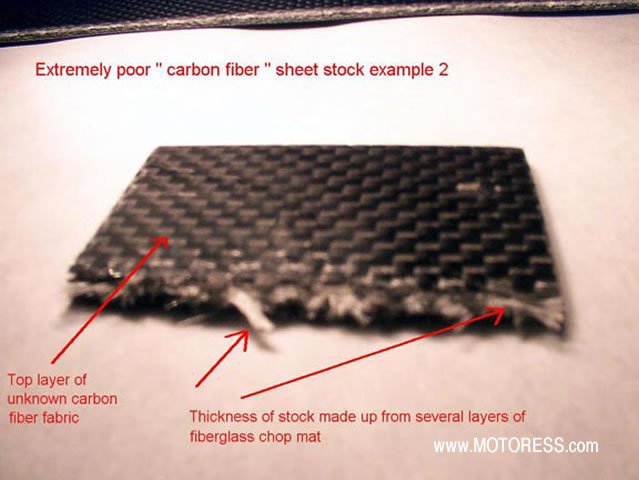
A uni-directional weaver (all strands running in same or one direction) gives strength in one particular direction for one particular force. A 2X2 twill weave (herringbone pattern) spreads its load carrying abilities evenly.
The problem with carbon fibre however is it looks good so people get carried away and stick everything conceivable with fake carbon fibre looking bits on their bike! We say don’t—rather tacky like owning an imitation pair of CHANEL sunglasses or anything for that matter!
Types of Carbon Fibre
WET LAY: This form is marginally more advanced than fibreglass. The dry carbon fibre matting is placed in a mould and painted with resin. And apart from getting the air out, that’s it. It will be lighter but brittle; usually shiny on the inside and relatively cheap – it’s basically useless if you want the real benefit of carbon fibre.
PRE-PREG: This uses a material that’s been pre-impregnated with resin; meantime the carbon fibre can be treated as a true predictable engineering material, with the fibre type and weaver pre-determined. Once it’s put into the mould it’s transferred to a bag and the air is sucked out to create a vacuum. Then put into an autoclave (oven and pressure vessel combined) and cured at about 130C, with 100psi acting on it to unite the materials reducing the chance of any voids or air weaknesses.
Things You Never Knew About Carbon Fibre (Carbon Fiber)
You should be able to fold a pre-preg carbon fibre piece and watch it bounce back. If you try that with most of the stuff you find on sale, and you’ll see white blister marks where the polyester resin used has fractured. This means unfortunately the majority of carbon fibre parts available for motorcycles are mostly poor quality. If it isn’t pre-preg it’s not worth having. None of the benefits of carbon fibres’ strength and light-weight will be evident.
Most exhaust cans have to use pre-preg carbon fibre because of repeated heat cycles the can goes through.
They go amber over time as the resin recurs repeatedly.