

Last Update: 3 June 2026
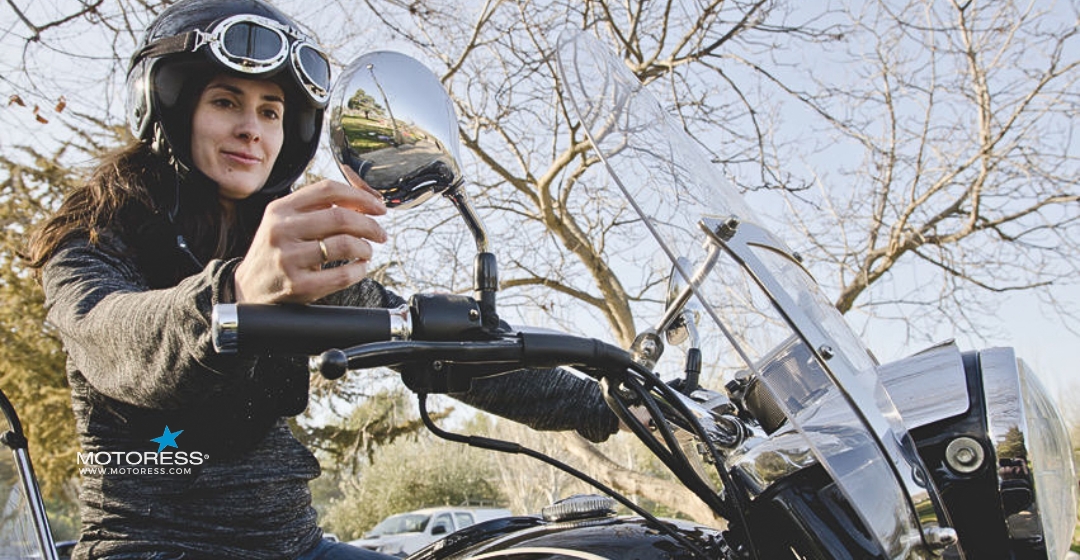
When riding a motorcycle, your vision is one of your most important lines of defence. You naturally have a clear view of what is happening ahead, but safe riding also depends on knowing what is happening beside and behind you. Blind spot checks, shoulder checks, and regular mirror use all work together to help you identify potential hazards early and give you more time to respond. Your motorcycle mirrors are one of your best resources for monitoring activity outside your immediate field of vision. Good mirror visibility supports safer riding, better decision-making, and greater overall riding enjoyment.
Motorcycle mirrors vary greatly depending on the manufacturer, model, and style of motorcycle. Sport bike mirrors, for example, are often designed to complement the bike’s aerodynamics, but they may not always provide the most generous rearward view in traffic. Mirror visibility should be an important consideration when choosing or setting up a motorcycle. Being able to see clearly behind and around you adds real value to your ride and plays an important role in rider risk management. Do not overlook mirror quality either. Mirrors that vibrate excessively, sit poorly, or offer limited rearward visibility can make a ride more stressful, tiring, and less safe.
How to Get the Most from Your Motorcycle Mirrors
Motorcycle mirrors are generally mounted either to the handlebars or to the front fairing. Handlebar-mounted mirrors usually sit on stalks secured by an adjusting nut. Before riding, check that the mirrors move freely enough to adjust, but are not so loose that wind, vibration, or road movement can shift them out of position.
Before adjusting your mirrors, take a moment to review your riding posture and position on the motorcycle. It may seem like a small detail, but your posture directly affects what you see in your mirrors. Sit upright, centred on the seat, with your head and shoulders in your natural riding position. Avoid slumping or sitting off-centre, as even a slight change in body position can alter your mirror view and reduce the accuracy of your adjustment. A comfortable, balanced position also helps reduce fatigue and allows you to keep more attention on traffic, road conditions, and decision-making.
With the motorcycle upright and the front wheel pointed straight ahead, adjust your mirrors from your normal riding position. As a baseline, aim to see the road behind you and the lanes to either side, with only a small portion of your shoulders or elbows visible. This helps maximise your rearward view while reducing unnecessary obstruction. If your handlebar-mounted mirrors do not allow this position, loosen the adjusting nut, reposition the mirror stalk, and tighten it securely. Fairing-mounted mirrors usually require only fine-tuning.
Your goal is to create the widest practical view behind and beside you. Some riders prefer their mirrors adjusted so the view overlaps slightly behind them, while others angle them farther outward to better monitor adjacent lanes. The best setting is the one that gives you useful rearward information without sacrificing awareness of traffic beside you. Once you are on the road, make any minor adjustments only while stopped and safely balanced.
Rider Quiz
A) Your shoulder and the lane behind.
B) About half of the lane behind you and as much as possible of the lane next to you.
C) The lane behind.
B) About half of the lane behind you and as much as possible of the lane next to you
Style Versus Visibility
Motorcycle mirrors come in many shapes and styles, including square, round, oval, oblong, and custom designs. They can be mounted to the handlebars, attached to the fairing or cowl, or positioned underneath the handlebars. While mirror style can enhance the look of your motorcycle, the most important factor is always visibility. Mirrors that are easy to see through and properly positioned make your ride safer, more comfortable, and more enjoyable.
Aftermarket mirrors are often chosen for appearance, but they should also improve function. If a different mirror design gives you a clearer, wider, or more stable view, it may be worth considering. Just be sure the mirror is not only attractive, but practical for real-world riding conditions.
You may also want to consider blind spot mirrors. These small convex mirror additions can provide a wider view of what is happening behind and beside you. They do take up a small amount of space on your existing mirrors, so they work best on mirrors large enough to accommodate them. Used properly, they can be a helpful addition, but they should never replace regular mirror checks, shoulder checks, and active scanning.
Don’t Rely On Mirrors Alone
Motorcycle mirrors help you stay aware, informed, and safer on the road. They provide valuable information about traffic behind and beside you, helping you judge speed, spacing, and potential risks before making decisions. But mirrors are only one part of your visual strategy.
No matter how well your mirrors are adjusted, they cannot show everything. Blind spots still exist, and relying only on your mirrors can create a false sense of security. This is why frequent shoulder checks, blind spot checks, and active scanning are essential. Many riders become complacent and skip these checks, but turning your head is still the most reliable way to confirm what is really around you.
The better you understand what your mirrors can and cannot show, the more effectively you can use them. Good mirror use should feel natural, quick, and intuitive—but it should always work together with full visual checks before changing position, changing lanes, turning, or moving away from a stop.
Good Mirror Practices to Reflect Upon
When evaluating your motorcycle mirrors, look for secure positioning, easy adjustment, wide rearward visibility, and a clear view of surrounding traffic conditions. These details may seem minor, but they play an important role in how confidently and safely you manage your ride.
Many riders do not think about mirror visibility when choosing a motorcycle, yet it can make a meaningful difference. Mirrors that are stable, well-positioned, and easy to read reduce stress and improve your ability to respond to changing traffic situations.
Good mirror visibility does more than support safety — it enhances the overall pleasure of riding. The more clearly you can see what is happening around you, the more relaxed, prepared, and connected you feel on every ride.
Safe riding!




2 comments
You are absolutely right Vicki, a really great article! Depending on your needs, you can choose the model of the mirrors!
Good post, Vicki.
The only thing I might add is that the value of a good pair of convex/racing/blind-spot (call them what you like) mirrors cannot be overstated. Convex mirrors give an outstanding field of vision behind your vehicle. Literally a 180 degree view.
The trade-off, of course, is that the images they display are somewhat “shrunk” in terms of actual size. Items that might appear in them…(as the passenger-side mirror on your car says) “may be closer than they appear”.
The trade-off is well worth it, however, because it is far more important to know IF something is there than to know how far away it is. The proximity of anything appearing in the mirror, if necessary, can and should be determined with a shoulder check or by simply switching your focus to the “regular” stock mirror.
I have inexpensive, self-adhesive, aftermarket convex mirrors attached to BOTH of my factory mirrors, and I don’t mind that they occupy up to half of the space on the stock items because their ability to totally eliminate blind spots is critical to knowing what’s going on around me.
If you love someone who rides, give them a pair of convex mirrors. And pick some up for yourself while you’re at it!