

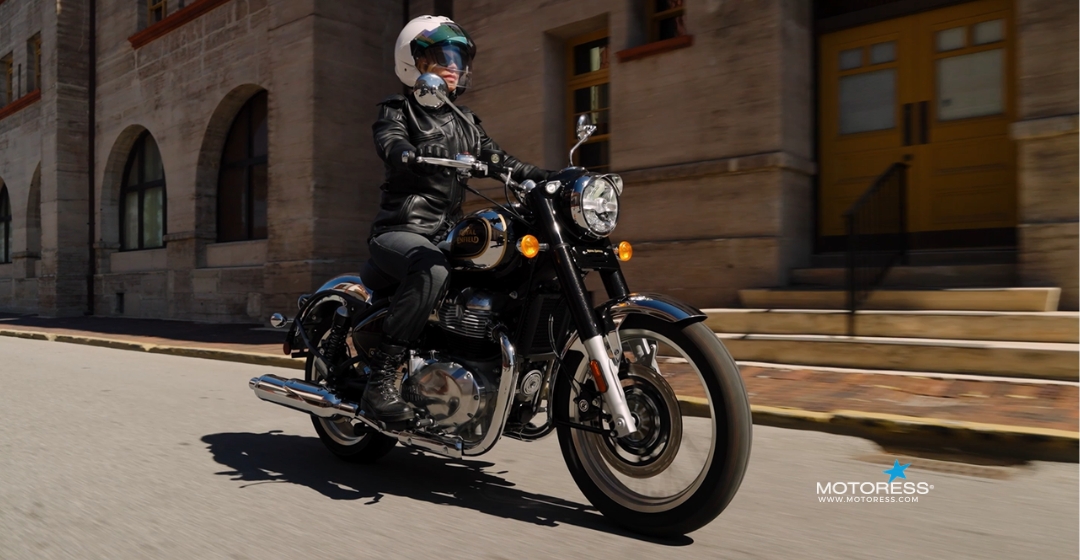
The 2026 Royal Enfield Classic 650 arrives as a particularly meaningful motorcycle for Royal Enfield. Introduced during the company’s 125th year, it is a completely new model that deliberately celebrates the brand’s enduring Classic lineage while adding the stature, refinement, and road presence of a parallel twin.
Its launch in St. Augustine, Florida felt intentionally chosen. As one of North America’s oldest cities, St. Augustine offered an atmosphere closely aligned with the motorcycle itself: historic, composed, and rich in visual character. Before riding began, Royal Enfield guided us through a curated display of historic models positioned on site — a thoughtful presentation reinforcing that the Classic 650 was being introduced not simply as another model, but as part of a long engineering story.
Launched in historic St. Augustine, the all-new Classic 650 twin introduces Royal Enfield’s timeless silhouette in parallel twin form — blending heritage design, thoughtful craftsmanship, and a more integrated riding experience.
That historical narration was led by Gordon May, Royal Enfield’s official historian, whose walk-through of the marque’s milestones sharpened the significance of this new motorcycle. The effect was immediate: the Classic 650 was presented as both modern launch and historical continuation.
The return of a parallel twin carries direct historical significance for the marque. Royal Enfield’s first parallel twin was unveiled at the 1948 London Motorcycle Show, known simply as the 500 Twin. That machine became influential not only for its engine configuration, but because it introduced a revolutionary swinging arm rear suspension at a time when most twin-cylinder motorcycles still relied on rigid frames or basic plunger systems.
Soon after, that same suspension design appeared on Royal Enfield’s road-going singles and twins, placing the company among the earliest full-production motorcycle manufacturers anywhere in the world to adopt a chassis concept that the rest of the industry would soon follow.
Now, decades later, the twin returns once again — but inside one of Royal Enfield’s most recognisable silhouettes.
Royal Enfield Classic 650 — Familiar Shape, New Substance
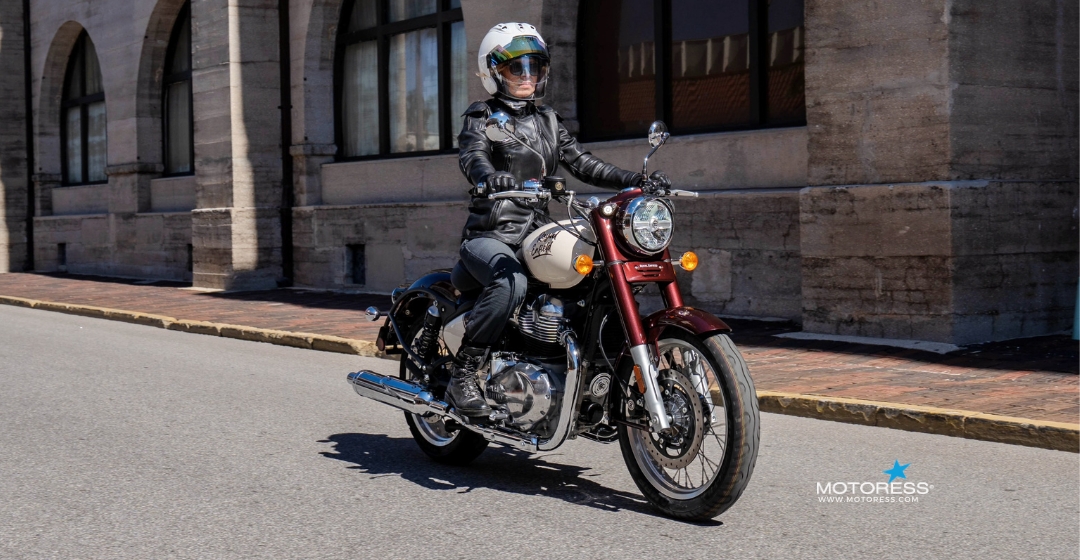
The most immediate connection to Royal Enfield heritage is the unmistakable frame loop design. That rear section of the steel chassis curves into a continuous, unbroken loop — a defining visual element linking the Classic 650 directly to earlier Royal Enfield models and post-war design language.
It is a small detail visually, but one carrying enormous significance.
That frame loop also connects the Classic 650 to Royal Enfield’s wider 650 platform family, including the Royal Enfield Super Meteor 650 and Royal Enfield Shotgun 650, although here it feels most closely tied to heritage intent.
Beyond that visual cue, however, the motorcycle establishes a distinctly new presence.
The stance has been carefully adapted around the larger twin-cylinder engine. Wider tires, altered proportions, and a slightly more planted visual footprint give the motorcycle noticeably greater substance than previous Classic models. The engine itself visually anchors the motorcycle in a way that feels entirely natural. This is not simply a larger Classic. It is proportionally reworked to suit what sits beneath it.
Design Details That Reflect Time Taken
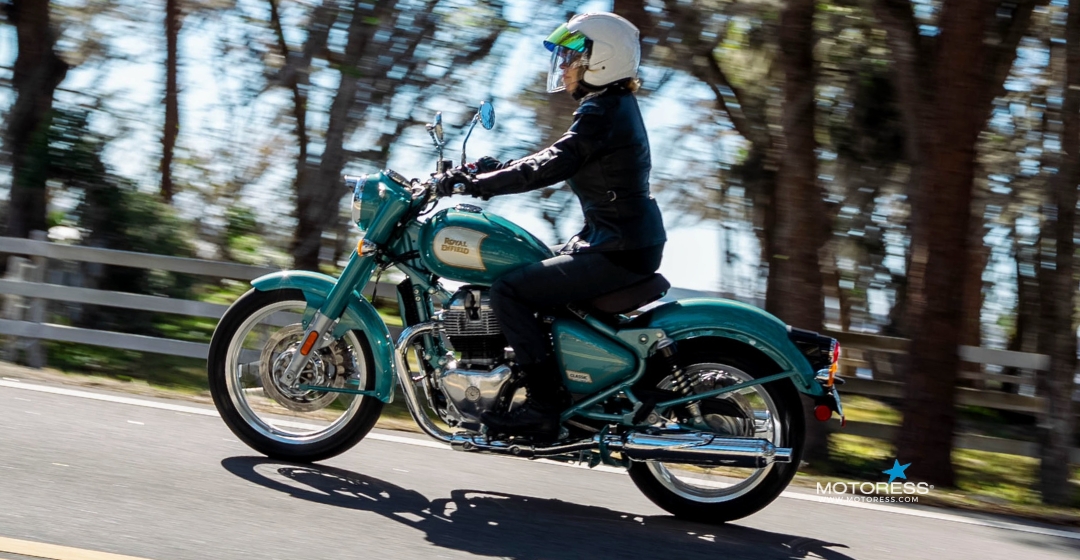
Royal Enfield has approached the finishing of the Classic 650 with unusual care. The nacelle headlamp immediately defines the motorcycle’s front profile — that enclosed headlight housing long associated with post-war British motorcycling, where the lamp and surrounding structure become a single integrated visual element rather than a simple mounted unit.
The result is instantly recognisable and entirely suited to the Classic’s identity.
The surrounding details reinforce that same discipline:
- hand-painted pinstripes
- embossed handlebar risers
- polished aluminium chromed side covers
- chromed ignition keys
- branded brake callipers
- K-line detailing along the frame
- peashooter silencers
Nothing feels decorative for its own sake. Instead, the motorcycle carries the impression that time was deliberately invested in details riders will continue noticing long after first impressions fade.
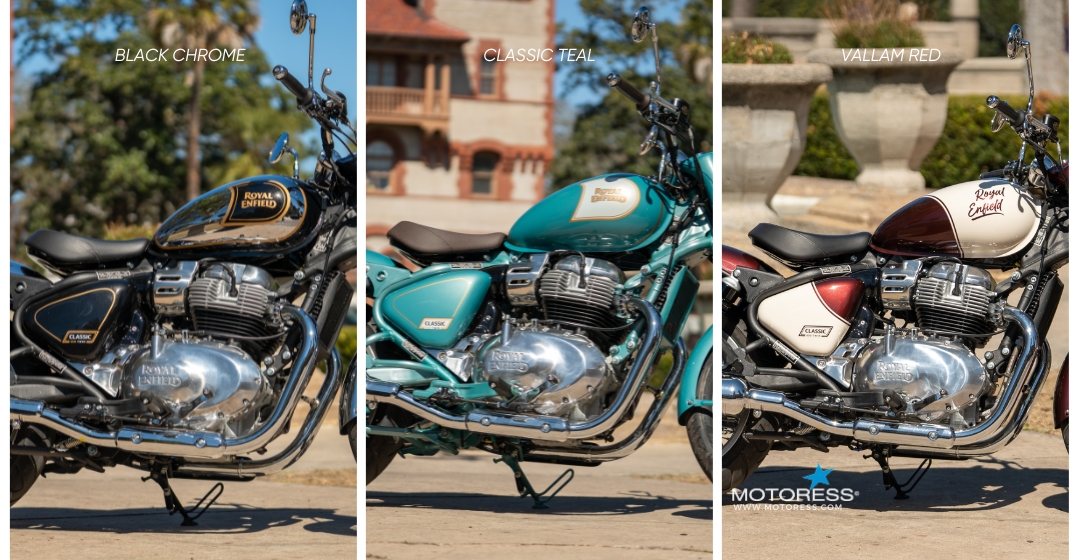
The Classic Teal colour finish shown at launch particularly suited the machine’s character, highlighting both the hand-finished detailing and the depth of its classic styling language.
Riding Position — More Into the Motorcycle
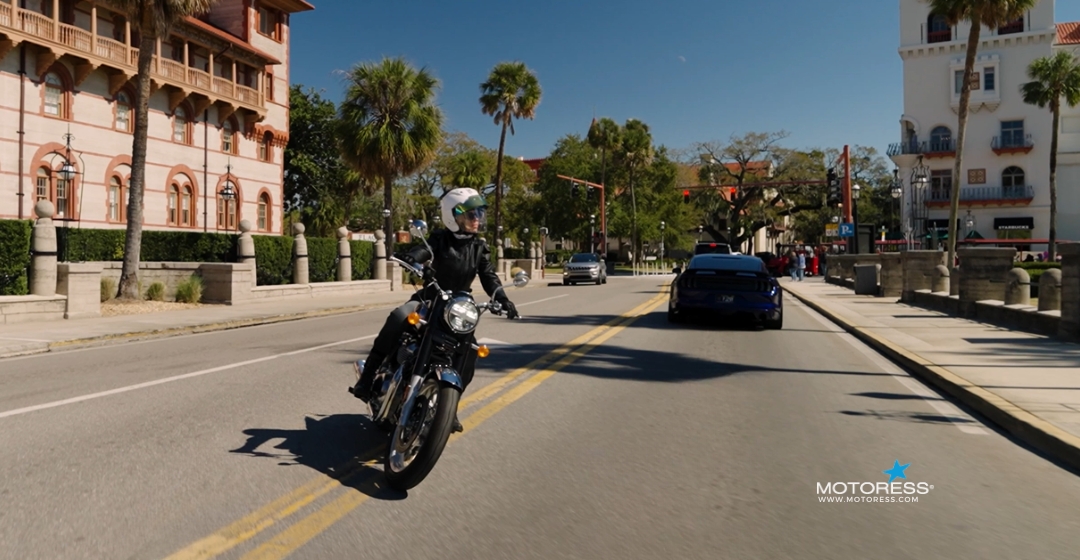
What becomes immediately clear once underway is that the Classic 650 changes how the rider occupies the motorcycle compared with smaller-capacity Classic models. The revised tyre dimensions, twin-cylinder architecture, and broader proportions create a riding position that places you more into the motorcycle rather than lightly above it.
That distinction is immediately noticeable.
- The handlebars sit closer and feel particularly well judged, allowing a natural reach that places the rider in a relaxed but connected posture. The upper body remains upright, preserving the Classic identity, yet the relationship between seat, bars, and tank gives a more integrated rider-machine connection. Rather than sitting on the motorcycle, you feel settled within it.
- At an accessible 800 mm seat height, the Classic 650 remains approachable for a wide range of riders, while the closer handlebar reach contributes significantly to rider confidence, particularly at lower speeds where balance and steering input matter most.
- The wider tires visually suggest added weight, yet once moving they contribute more to planted feel than heaviness.
- The motorcycle remains reassuring at slow speed and easy to place.
- The parallel twin introduces a maturity that suits this platform exceptionally well.
- Throttle response feels predictable, measured, and entirely suited to the Classic’s character.
Nothing feels abrupt. Instead, the motorcycle rewards smoothness.
2026 Royal Enfield Classic 650 Twin Photo Gallery
Final Thoughts
What Royal Enfield has achieved with the Classic 650 twin is not merely the enlargement of a familiar model, but the careful preservation of identity while introducing a motorcycle with noticeably greater substance.
That is not easily done.
Many heritage motorcycles lose authenticity when engine size increases. They often become visually overworked or disconnected from the simplicity that made them appealing in the first place.
The Classic 650 avoids that.
It retains the unmistakable silhouette, the visual restraint, and the calm mechanical honesty that define the Classic name, while delivering stronger road presence and a more mature rider experience.
For experienced riders, there is satisfaction in how deliberately this machine has been developed.
For riders stepping upward in capacity, there is reassurance in how naturally confidence arrives.
Manufacturer Specifications
Beyond the heritage styling, the Classic 650’s technical package reveals how deliberately Royal Enfield has adapted the platform to preserve classic character while improving rider integration.
- Parallel 650 twin engine
- 800 mm seat height
- 3.8 gallon / 17 litre fuel tank
- Showa rear suspension
- Twin seat with removable pillion option
- Tripper navigation pod
- Peashooter silencers
- Hand-painted pinstripes (truly by hand!)
- Nacelle headlamp
- Wider tires matched to twin-cylinder platform
- Three colour ways: Classic Teal, Black Chrome and Vallam Red.
Suggested Retail Price: $9,999 CAD ; USA: Check local Royal Enfield dealer / U.S. model page for current pricing
Some motorcycles ask to impress you immediately. The 2026 Royal Enfield Classic 650 simply settles in — and that may be exactly why it leaves such a lasting impression!
To see one up close find a Royal Enfield near you – check their website.