

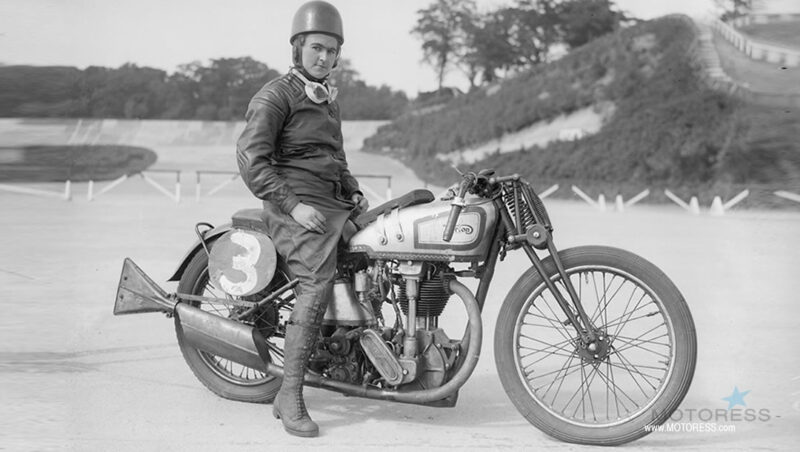
Beatrice Shilling was born in 1909, and that’s just one year after the beginnings of International Women’s Day! This was also just six years after the British suffragette movement. It was an era when women demanded gender equality, and when Shilling made history in both motorcycle racing and the field of STEM (Science, Technology, Engineering, Mathematics). Shilling bought her first motorcycle at just 14-years-old, learnt to strip and rebuild the engine to take her bike to its ultimate limits. And in 1936, Shilling became one of only three women to ever win the Gold Star at the Brooklands circuit, completing a lap with an average speed of 106mph on her Norton M30 500cc. The fastest it had ever been achieved in her time.
Unafraid to follow her dreams in a male-dominated industry, Shilling studied electrical engineering at The University of Manchester in 1929. She then landed a job within the publications department of the Royal Aircraft Establishment in 1936, writing manuals for aeroplane engines. Soon, she began working on the aircraft engines herself, and was promoted to technical officer in 1939, the year Britain entered the Second World War.

Shilling, known as Tilly to her friends, was a remarkably gifted British engineer who in 1936 was recruited to serve as a scientific officer in the Royal Aircraft Establishment (RAE), a position she held until her retirement in 1969. Shilling’s decision to join the RAE had a lasting effect not only on her life but also may have saved the lives of pilots and soldiers in World War II.
This is when Shilling became an essential element in Britain’s defence against invasion. The Rolls-Royce Merlin engine of the famous RAF fighter planes, the Spitfire and Hurricane, had one fatal flaw. When the pilots needed to make a steep dive, fuel would flood the carburettor, making it splutter or cut out, and giving the German aircrafts the advantage in the attack. Shilling designed the R.A.E. restrictor, a washer that could be fitted into the fuel pipe of the plane’s engine, to reduce the flow of fuel when the pilot made a steep dive. Drawing on the knowledge she gained from manipulating the fuel pipes of her Norton engine, Shilling’s innovation was ground-breaking. The Royal Aircraft Establishment and pilots alike put all their faith in Shilling’s invention, nicknaming it “Miss Shilling’s orifice.” Beatrice Shilling was awarded the OBE in 1947 for her work during World War II and worked at the Royal Aircraft Establishment until her retirement in 1969.
In a 1969 letter, Shilling recalled her arrival at the RAE in 1936. According to northropgrumman.com, Shilling wrote, “The Air Ministry, having had some experience of women’s work in the First World War, were not entirely unsympathetic, and I was offered a job as an assistant in the Technical Publications Department at the Establishment.” After spending eight months writing aero-engine handbooks, she was transferred to the engine department, where she specialised in research and development on carburettors, a much better match for her skills and interest.
Beatrice Shilling Known As “Tilly”
The number of women in engineering is drastically growing. There was a 77% increase in degrees awarded to women in engineering fields between 2010 and 2016. And whilst women made up just 1% of all engineers in 1960, that number rose to 11% by the year 2000.

Shilling wasn’t just mechanically inclined, either; she also became a proficient motorcycle racer in the 1930s, lapping Brooklands at 106 mph on her Norton M30 500 to earn a gold star. She also raced four-wheeled machines, driving a 1935 Lagonda at Silverstone and later racing sports cars at Goodwood in the 1950s.
Beatrice Shilling paved the way for women to take to the road on two wheels. She challenged gender bias by innovating in the field of engineering, propelling Britain towards military success. Her achievements demonstrate just how crucial women are to this industry. Today, and every day, we choose to challenge inequality in the workplace and on the tracks and celebrate women’s contributions to STEM.

Shilling had an early love of motorcycles which began at age 14. Soon after graduating she took up motorcycle racing at Brooklands, on a Norton that she modified herself. In August 1934 she became only the second woman lapping Brooklands at 106 mph on her Norton M30 500 to earn a gold star. She also raced four-wheeled machines, driving a 1935 Lagonda at Silverstone and later racing sports cars at Goodwood in the 1950s.
Shilling married her husband, George Naylor, in September 1938. He also worked at the RAE. According to rumour she refused to marry him until he also had been awarded the Brooklands Gold Star for lapping the circuit at over 100 mph. During the Second World War he was a bomber pilot with No. 625 Squadron RAF, reached the rank of Flight Lieutenant and was awarded the Distinguished Flying Cross (DFC).
“Beatrice Shilling is an inspiration to us all,” stated Mark Burnett, managing director for Burlen Limited, which still manufactures and supplies SU carburetors around the world. “Not only was she a first-class engineer but she also loved speed and was fast on both two wheels and four. “Miss Shilling should be celebrated and remembered for the incredible woman she was, and as an engineer who made wartime pilots lives as safe as they could be when in battle.”
Years later—and after her death in 1990—we shall always salute Beatrice Shilling, whose inquisitive mind and quest for speed and adventure broke the mould.
Her contributions to the Allied Forces in World War II are a testament to her lasting legacy.